The Trough Is Almost Over: What the Gartner AI Hype Cycle Means for Your Organization Right Now
A strategic guide for leaders ready to move from caution to confident, measurable AI adoption
Every transformative technology follows a pattern.
The dot-com era is the clearest modern example:
a genuine technological breakthrough, followed by irrational exuberance, hundreds of billions in speculative investment, thousands of business failures — and once the wreckage cleared, the companies and infrastructure that reshaped the global economy took hold.
Amazon, Google, and the internet itself didn't disappear in the bust.
They solidified their position as the foundation everything else was built on.
AI is following a similar hype arc.
The past three years delivered the frenzy: bold claims, board-level pressure to move fast, pilot projects that consumed real budget and returned ambiguous results, and a wave of vendor promises that outpaced what the technology could actually deliver.
Now comes the correction.
We are in the Gartner AI Hype Cycle's Trough of Disillusionment.
Failed pilots are being shelved.
AI budgets are being scrutinized.
Skepticism is rising.
This isn't a signal that AI was overstated as a technology.
It's the hype cycle working exactly as it always has.
And just as the dot-com bust separated the durable from the disposable, this trough is doing the same for AI. What survives will be foundational. The organizations that capitalize on this moment clearly are the ones that will define the next decade.
If your organization held back from diving headfirst into AI without a clear strategy, clean data, or a prepared workforce, that caution paid off.
You waited, watched, and learned — now is the time to use that advantage.
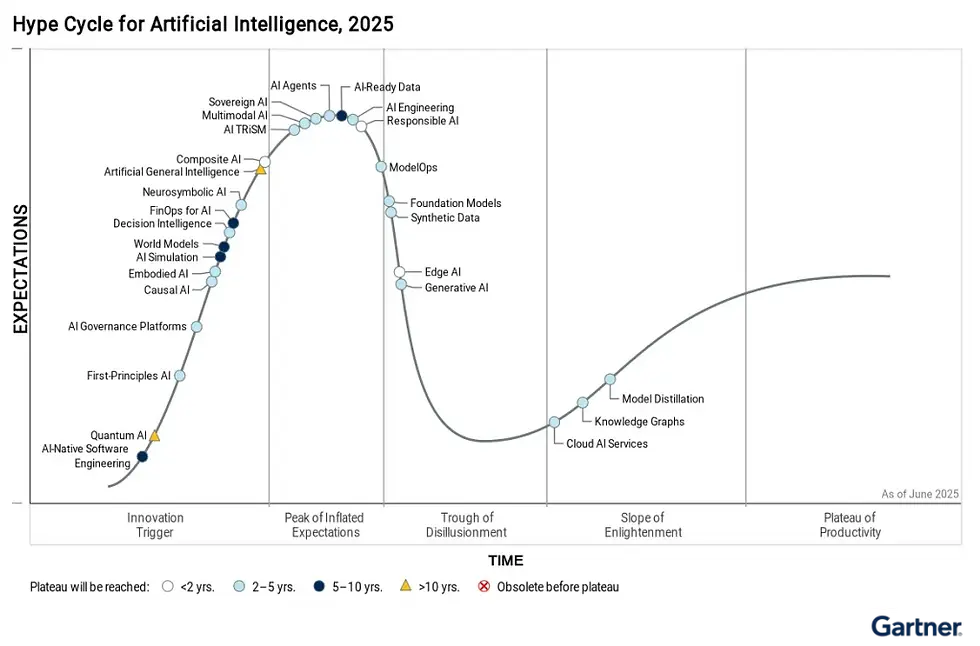
What Is the Gartner AI Hype Cycle?
The Gartner Hype Cycle is a framework developed by research and advisory firm Gartner to map the maturity, adoption, and business application of specific technologies over time. It traces a predictable arc that most transformative technologies follow: from initial excitement through disappointment, and ultimately to productive, stable deployment.
The five stages are:
Innovation Trigger: A technology breakthrough sparks significant media coverage and industry interest. Early proof-of-concept stories emerge, though few commercially viable products exist.
Peak of Inflated Expectations: Frenzy sets in. Early success stories, often overhyped, generate unrealistic expectations. Failures begin accumulating quietly in the background.
Trough of Disillusionment: Interest wanes. Pilots fail to deliver at scale. Vendors consolidate or exit. Investment slows. Organizations that over-committed begin counting the cost.
Slope of Enlightenment: Surviving technologies demonstrate real-world value through second- and third-generation deployments. More organizations begin piloting successfully. Best practices emerge.
Plateau of Productivity: Mainstream adoption takes hold. Methodologies mature. ROI becomes clearly demonstrable. The technology becomes an expected part of organizational capability.
Where is AI right now?
As of 2025, many general-purpose AI capabilities (including large language models and enterprise AI platforms) are moving through the Trough of Disillusionment and approaching the Slope of Enlightenment.
The hype is clearing and the value is becoming visible.
The Trough of Disillusionment: Why It's Actually Good News
"Trough" sounds grim. But for organizations that approach it with clear eyes, it is one of the most valuable filters a technology cycle can provide.
Here is what the trough has done for AI:
Eliminated the noise.
The use cases built on hype (AI tools deployed without defined problems, clean data, or structured pilots) have largely stalled or been quietly shelved. What remains are the deployments built on substance: clear ROI, sound governance, and genuine alignment to business outcomes.
Separated trendy tools from reliable platforms.
The AI vendor landscape has consolidated significantly. The platforms that survived the trough and are scaling through the slope of enlightenment are demonstrably more mature, more reliable, and better supported than what existed in 2022. Organizations adopting AI today are building on stronger, proven foundations.
Validated the cautious approach.
Organizations that insisted on data readiness before deployment, required governance frameworks before tool rollout, and prioritized staff input and preparation over speed avoided the most painful consequences of innovation hype.
The Slope of Enlightenment: What Practical AI Adoption Actually Looks Like
The Slope of Enlightenment is where we move beyond bold claims, scattered tools and ambitious pilots. This stage of the cycle is defined by organizations solving real problems with AI, measuring the results, and building repeatable playbooks for doing it again.
In practice, organizations on the slope of enlightenment share several characteristics:
AI use cases are defined and tied to specific, measurable business outcomes.
Not "we need an AI strategy" but "we're using AI to reduce invoice processing time by 40% and redirect three FTEs to higher-value work."
Data is in order.
Organizations succeeding with AI have invested in data infrastructure, quality, and governance before deploying models.
Staff are prepared and supported.
Staff understand the tools, the policies, the guardrails, and the governance frameworks. They use AI with confidence and accountability.
Governance is treated as an enabler, not a constraint.
Clear policies around AI acceptable use, data handling, security protocols give employees the confidence to leverage AI within defined boundaries. It's the foundation that makes scalable deployment possible.
The most important shift on the slope of enlightenment is a cultural one:
AI moves from being an experiment to being an operational capability.
It's a business tool, governed and used by the people closest to the work.
"The organizations best positioned as we reach the slope of enlightenment chose patience over speed and reactivity — with clarity on use cases, readiness in their data and people, and governance built in from day one."
Odyssey's Recommended Next Steps: Designing Your 2-5 Year AI Roadmap
If your organization has been cautious about AI adoption, you haven't fallen behind or missed your moment. You are well-positioned to have avoided the peak of inflated expectations.
We recommend a sequenced approach to AI roadmap design that prioritizes strategic clarity at every stage and avoids the costly mistakes that defined the hype era.
Odyssey Partners brings a consistent framework to every AI engagement:
Step 1: Assess Your Readiness Baseline
Before any tool selection or deployment, conduct an honest assessment of where you stand today.
This means evaluating:
data infrastructure and quality
current technology landscape and integration points
staff's digital literacy and AI awareness
governance structures or gaps that exist around technology use
Identifying and resolving the gaps, errors, and pain points in your current environment is the starting point — and it cannot be skipped.
Step 2: Define Your North Star
What problems are you actually trying to solve? The organizations that succeed with AI in the long run are the ones that start with the business challenge, not the technology.
Identify two to four high-priority use cases where AI can deliver measurable value, such as:
reduced cost
improved accuracy
faster turnaround
enhanced customer experience
Then build your roadmap around those anchors.
Step 3: Design Your Governance Framework First
Treating governance as a post-deployment afterthought is where most organizations get the sequence wrong.
Your governance framework should establish the foundation of how your organization uses AI, addressing:
AI TRiSM principles (Trust, Risk, and Security Management)
acceptable use policies
data handling and privacy protocols
role-based access controls
mechanisms for monitoring AI outputs and catching errors
When designed and integrated effectively, governance doesn't slow you down. It gives your people the confidence and guardrails to move decisively and use AI well.
Step 4: Prioritize Staff Enablement Over Tool Deployment
The most sophisticated AI platform in the world underperforms when deployed to unprepared teams. The organizations realizing the greatest value from AI are investing as heavily in their people as in their technology.
This means tailored AI training programs that address:
different roles and use cases
tools selected by your organization
education on governance and responsible use
change management to address resistance and build trust
ongoing reinforcement as tools and policies evolve
Confident, trained teams don't limit AI use to copy editing and search filtering. They find new ways to apply it, expand its value, and identify problems before they escalate.
Step 5: Build a Phased Roadmap
A well-designed AI roadmap sequences initiatives to build momentum, demonstrate value, and develop organizational capability over time.
We recommend structuring your roadmap in three horizons:
90-day quick wins phase:
focuses on top opportunities that build confidence and demonstrate ROI
6-12 month preparation phase:
expands proven use cases and deepens governance infrastructure
2-5 year strategic vision phase
positions AI as a core operational and competitive capability across the organization
Patience Was the Strategy. Action Is Next.
The Trough of Disillusionment is almost behind us. The Slope of Enlightenment is coming, and the Plateau of Productivity is visible on the horizon.
The dot-com bust did not end the internet.
It ended the companies that had no real foundation under them.
What followed was two decades of infrastructure, innovation, and economic transformation built by the organizations that survived the correction and moved with purpose.
AI is at the same inflection point.
The hype has cleared.
The durable value is coming into focus.
The organizations that move deliberately, with governance and people at the center now will look back on this moment as when they made the decision that mattered.
Move Forward with Clarity
Odyssey Partners Consulting helps mid-market organizations move from AI ambiguity to strategic action. We bring CIO-level advisory support to design AI roadmaps from the foundation up: strategic clarity, staff enablement, governance design, and phased implementation built for lasting results.
If you're ready to take strategic action on AI, let's start the conversation.
Connect with the Odyssey Partners team to schedule a complimentary AI consultation and turn AI ambition into a clear, strategic path forward.

Microsoft 365 Technical Solutions Architect
Rob is a seasoned Technical Solutions Architect with over 25 years of experience in IT. He specializes in cloud computing, networking, and cybersecurity. Rob excels in designing and implementing comprehensive, enterprise-scale solutions, integrating advanced AI capabilities.
Comments